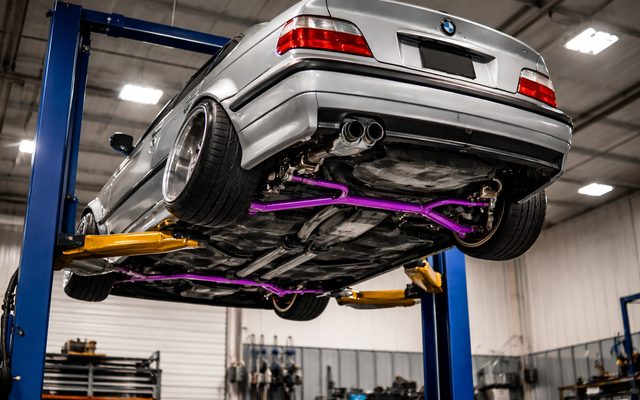
Within the high-stakes world of contemporary professional sliding, podium finishes is not merely purely a function of brute horsepower or behind-the-wheel bravado. Conversely, it has evolved into a intricate engineering challenge that necessitates a painstaking blend of selecting a inherently capable vehicle platform, equipping it with the correct performance parts, and, most importantly, understanding its real-time characteristics on the track through advanced suspension tuning applications. This exhaustive guide acts as your blueprint starting from the very first idea of a drift build through to the last data-informed tweaks that turn a strong vehicle into a consistent winner. We will thoroughly explore the methodical process of car suspension tuning, demonstrating how a modern vehicle dynamics tool like GripDial eliminates guesswork and provides unparalleled insight into your vehicle's true performance.
The foundation of any great drift car is, without question, the chassis itself. Certain platforms have achieved iconic reputation within the worldwide oversteer culture due to their built-in weight distribution, durable design, and the vast ecosystem of aftermarket components available. Picking the optimal car is the initial and most significant decision a builder will make. To illustrate, the the E36 generation BMW is commonly accepted as among the finest all-around drift cars of the modern era. Its excellent balanced front-to-rear weight, combined with a rear-wheel-drive layout and robust straight-six engines, creates a car that is simultaneously accessible for beginners and incredibly competitive in the control of a professional competitor. The successor of this lineage, the BMW E46 platform, improves on these strengths with a even more sophisticated chassis, increased wheel track for enhanced confidence, and still more turning capability directly from the OEM. A different formidable option in the pro scene is the C6 generation Corvette.
This American track weapon brings a particular array of strengths to the sliding sport, such as a lightweight aluminium chassis, a transaxle-style transaxle that helps create an excellent balance, and the immense low-end power of a large-displacement LS V8 motor. This combination renders it an complete monster on track, designed of initiating and holding long slides with relatively effortless use of throttle. For builders desiring exceptional bang-for-the-buck, the Nissan Z33 stands out as a excellent candidate. It comes from the manufacturer with a robust chassis, a effective original limited-slip differential, and the free-revving V6 engine that offers plenty of power and torque for mastering and moving up in the discipline. Its successor, the 370Z model, brings further refinements in structural rigidity, handling precision, and outright engine power, establishing its status as a favorite choice among competitive drivers. Further legendary platforms that merit consideration are the agile unique Mazda FC RX-7, the ubiquitous S13 Silvia/240SX, the V8-powered Ford SN95, the electronic-equipped BMW E90, and the small yet incredibly fun and teachable MX-5 Miata. Every single one of these cars offers a distinct array of traits, complexities, and possibilities, but they all possess the basic components essential to serve as a serious sliding vehicle.
However, picking the optimal platform is just the starting point. To access the complete capability of every of these cars, substantial upgrades to the steering system and suspension systems are absolutely non-negotiable. This is where the domain of precision drift-spec hardware enters critical view. The single most transformative upgrade for a purpose-built competition vehicle is the integration of a maximum-angle steering angle kit. These sophisticated kits, for example those manufactured by specialist companies like SLR Speed, are designed to radically expand the car's available steering angle. A OEM road car is extremely limited in how far its tires can rotate, a engineering compromise for daily driving. In drifting, conversely, maximum countersteering is frequently needed to catch and maintain a drift. An steering kit replaces the stock uprights, linkages, and often control arms with pieces that enable the wheels to attain angles over 70 or even 80 degs, compared to a normal stock angle of around 40 to 50 degs.
This vastly expanded steering angle gives the driver with significantly more authority during a drift, enabling it to be much more straightforward to start a oversteer moment, maintain it through a sweeping corner, and change smoothly from one side to another. The contrast in handling is nothing short of profound. Paired with a correctly selected steering kit is the every bit as critical enhancement to the vehicle's damping system. Generic or even premium sport adjustable suspension are generally not designed for the specific and extreme demands of sliding. A drift-spec set of adjustable dampers is of utmost importance. These specialized dampers have custom damping rates and spring stiffness that are designed for the violent load shifting that is typical of drifting. When a driver starts a angle, the chassis's mass is transferred rapidly to the front of the bend. Proper competition dampers handle this shift in a predictable manner, enabling the car to find its balance promptly and giving the driver clear feel through the wheel and cockpit. They furthermore provide precise adjustment of ride height, rebound and compression firmness, and cross-weight, which are all fundamental elements of optimizing the chassis's handling to a specific track or driving style. Together, a high-quality steering angle kit and a correctly selected system of competition adjustable dampers constitute the undeniable physical base upon which all subsequent tuning is built.
Once the core hardware is installed, the next vital step in the development is the detailed tuning of the car's suspension geometry. This is the domain of vehicle alignment optimization, a process that can seem daunting to the beginner but is, in practice, the defining factor to converting a assembly of fast parts into a harmonious and controllable vehicle. The most debated aspect of alignment for oversteer is certainly camber angle. Camber is the angle of the rim in relation to the vertical axis when looked at from the front-on of the vehicle. When the top edge of the wheel is tilted towards the chassis, this is known as camber-in. For oversteer driving, an inward tilt on the front tires is generally employed and is seen as necessary. The reason is deeply car suspension tuning tied to physics.
When a chassis is turning at extreme sideways angles, the chassis tilts towards the outside of the bend. This chassis roll forces the outside steering tire to lose its optimal contact patch with the tarmac. By applying negative camber, the wheel is pre-angled to counteract this roll. As the chassis rolls into the corner, the outside front tire gains a better contact patch with the road surface, maximizing its grip at the critical moment when it is most required for steering authority. Commonly, front adjustments for a dedicated drift car vary from approximately -3 degrees to as high as -5 degrees or even beyond, contingent on the details of the car setup, tire selection, and operator preference. The back wheels also employ inward tilt, but the settings are generally more conservative and less aggressive than the front. Overly aggressive negative camber at the back can cause the vehicle to overly tail-happy and challenging to predict on acceleration input, as it diminishes the effective grip area of the driven tires during linear acceleration. Thus, rear axle camber settings are frequently in the ballpark of -1 degree to -3 degrees, achieving a delicate compromise between offering sufficient side traction to help in initiating and sustaining the slide while simultaneously maintaining usable traction for power-down the corner. alignment is only one element of the broader suspension geometry puzzle, which furthermore encompasses toe setting, caster, and suspension-induced steering adjustment.
Toe angle refers to the angle of the tires as seen from the top. Inward toe means the front edges of the wheels are nearer together than the trailing edges, while outward toe means the converse. For oversteer, a modest amount of front negative toe is frequently used to sharpen the turn-in handling feel, making the chassis feel more agile and willing to begin a slide. Rear toe is generally set to neutral or a incredibly small amount of positive toe to encourage predictability under power. caster angle is the frontwards or rearward angle of the suspension pivot when observed from the lateral of the vehicle. Positive caster increases self-centering and stability solidity, and it also adds to camber effect during turning, which is very beneficial. Adjusting these parameters is a intricate interplay where a modification to a single value can and will affect the other settings. The old-school process for tuning a vehicle's alignment for sliding has for a long time been a time-consuming affair of guesswork and adjustment. A pilot or crew would apply a change based on a hunch, drive the vehicle on coilover setup tips track, rely on the operator's subjective feel and comments, and then make another tweak. This loop would repeat time after time until the car felt "acceptable" or the available practice session was exhausted. This system is not just incredibly slow in drift angle kits terms of time and tires, fuel, and parts, but it is additionally fundamentally flawed.
Human sensation is a infamously unreliable measurement tool, colored by many variables such as fatigue, varying track conditions, weather, and simply the focus of the pilot on that given session. What feels "tail-happy" on one run might feel "pushing" on the following pass, resulting in confusing information and frustrating changes. This age-old problem in car suspension tuning is exactly where modern telemetry systems has stepped in to transform the process.
The rise and integration of sophisticated drift telemetry software has brought about a radically different age for tuning and optimizing high-performance sliding vehicles. These tools, showcased by innovative solutions like GripDial, operate by physically recording the real-time mechanical performance of the vehicle as it is operated on the circuit. As opposed to relying on personal feedback, these devices gather quantifiable information on essential parameters such as shock absorber movement, wheel speed, G-force loading, lock position, and throttle and brake application. This collected information flow is then interpreted by sophisticated software that can visualize and analyze the data in a comprehensible format. For the first time ever, tuners and teams can see exactly what the vehicle is performing at any given moment of a lap. This function revolutionizes the complete chassis setup process. Consider the specific challenge of dialing in the front camber for a particular car. Instead of making a change from -3 degrees to -3.5 degrees and then driving multiple laps to try and "feel" a improvement, a suspension tuning tool can provide real-time and definitive information. The tool can indicate visually how the wheel's grip is behaving during the critical phases of a drift: the initial flick, holding the angle, and changing direction. It can show if the existing camber setting is allowing the outside front tire to achieve ideal grip or if the rubber is overloaded on its outer shoulder.
The software can subsequently make data-driven advice for modification. Perhaps the telemetry indicates that the tire is even stressing its edge at -3.5 degrees of camber, implying that an increase to inward lean, say -4 degrees, might be beneficial. Alternatively, the information might show that the tread is failing to reaching temperature or that the inside shoulder is wearing unevenly, which could indicate that there is too much angle and a small reduction back to -3.2 degrees would be more ideal. This level of granularity and actionable analysis was literally unimaginable in the time of solely mechanical adjustment.
The impact of employing a advanced vehicle dynamics tool reaches well beyond only dialing in camber. It serves as an invaluable damper adjustment manual that is tailored to your particular vehicle. When setting the rebound and compression clickers on your adjustable dampers, rather than depending on general tips or replicating another driver's numbers, you can use the data to see how the car is performing in relation to your tweaks. The software can graph the suspension travel path over a section of track, showing if the coilovers are controlling the body movement optimally or if they are permitting the vehicle to bounce too much after a flick. It can help in identifying challenges like bottoming out or losing droop, enabling you to make educated adjustments to spring preload, rebound/compression values, or ride height. This methodology translates similarly to the complex process of corner balancing. In addition to camber, the tool can give analysis into how modifications to toe and caster are impacting the chassis's handling during different phases of a slide. For instance, it can allow you to determine the optimal amount of front toe out for your particular angle kit geometry and driving style by analyzing the quickness of turn-in reaction and the predictability of the vehicle at lock steering angle. This makes the system an extremely effective performance optimization handbook that is constantly calibrated by the live performance of your own car on the track. It moves the entire endeavor from a dark art into a repeatable engineering exercise.
Furthermore, the utility of a system like GripDial is not limited to experienced teams with extensive funding. For the club-level competitor, it functions as an powerful educational tool. It practically gives the driver with the knowledge of a professional race engineer without the associated overhead. It drastically shortens the tuning process by giving unambiguous answers to questions that would normally take countless track days of trial and error to answer. A driver can learn how their individual vehicle reacts to different inputs, gaining a more profound comprehension of vehicle dynamics in the journey. It furthermore makes accessible high-level suspension engineering techniques, enabling anyone with the ambition to optimize their car to do so in a efficient and productive manner. This is notably valuable in a sport like oversteer competition, where tuning knowledge has in the past been a tightly held commodity among professional drivers. In the modern era, that capability can be in the hands of every serious builder.
In summary, the journey to constructing and tuning the ideal championship-contending drift car is a comprehensive endeavor that smoothly integrates proven hardware knowledge with revolutionary telemetry tools. It commences with the wise pick of a capable car, then enhanced by the application of critical competition components like drift-spec drift angle kits and correctly valved competition suspension units. The journey then moves into the detailed phase of car suspension tuning, where settings like negative camber, toe, and caster are precisely adjusted to suit the chassis's modified hardware and the driver's individual technique. The final step, and what truly distinguishes the today's approach from the old ways, is the use of a sophisticated vehicle dynamics tool. This platform eliminates the uncertainty and waste of solely subjective adjustment by giving objective, live telemetry on how the chassis is really performing. It acts as an unparalleled engineering partner, a actionable drift suspension tuning guide, and a comprehensive performance analyzer. As a complete package, this complete approach leads to that all component of the drift car—from the selection of the chassis to the last adjustment on the coilover—is refined for peak competitiveness on the track. It represents the full evolution of the sport of drifting, bridging raw driving skill with surgical chassis dynamics to build the most effective machines possible.